
My feed is full of AI right now. Debates, anecdotes, prophecies, dread. Every day someone declares that large language models are about to end a profession, and every day someone else declares the whole thing a parlour trick. Both camps write with enormous confidence.
I use these tools hard. I write software with them, I run cybersecurity work through them, and I lean on them for the business side of WitFoo most days of the week. (If you want the receipts, I have been documenting that in the Coding with Claude series for the better part of a year.) That much daily contact gives me a perspective I think is useful, mostly because it is unromantic.
I am not swooning and I am not sneering. (I have spent a decade and a half on this blog parsing overconfident vendor claims in security, so I would rather not swap vendor magic thinking for AI magic thinking.) I am just using the thing. So here is the most useful way I have found to think about what a language model actually does. It is a guess. A very good guess. And once you see it that way, the magic thinking and the cynicism both fall apart at the same time.
Two ways to learn your weight
Picture the bloke at the carnival who guesses your weight. He looks at your height, your build, the way you carry yourself, your shoes, the way you walk up to the booth. He runs all of that against the thousands of people he has sized up before, and he calls a number. He is right more often than he is wrong, and every time the scale settles he learns a little and his next guess gets sharper. That is predictive analysis. He never actually weighs you. He infers.
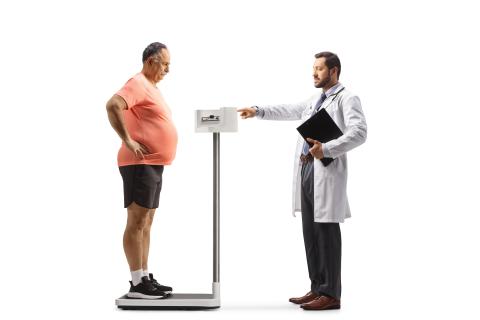
Now picture your doctor. She does not guess your weight. She puts you on a scale and reads the number. That is deterministic analysis. There is no inference and no confidence interval. There is a measurement.
Here is the part people skip: in both cases a scale gets involved. The difference is that the carnival worker predicts the answer first and the scale only confirms it, while the doctor goes straight to the scale. A language model is the carnival worker. It is trained on enormous datasets so that its guesses land close, and it improves the same way he does (better data, more cycles, sharper guesses). I drew a version of this distinction years ago in 4 Types of Data Analytics. The language-model era has just made it the most important distinction in computing.
We already do this dance
The thing is, humans run on prediction constantly, and we are fine with it. Your doctor does not start with a measurement. She starts with a guess. You describe a cough, she forms one or two likely explanations, and then she orders tests to kill or confirm each one. Predict, then measure. The prediction narrows what to measure, and the measurement disciplines the next prediction. That back-and-forth (educated guess, hard test, educated guess, hard test) continues until she reaches a conclusion she can defend.
A more experienced doctor makes better opening guesses than a junior one. Not because she is smarter, but because she has seen more (a bigger dataset of similar quality). That is exactly the difference between a small model and a large one. More good examples, better guesses.
Why agents are the exciting part
For a long time a language model could only do the first half of the doctor's job. It could guess, and that was the end of it. What makes the current moment genuinely interesting (and what the word agentic
is gesturing at) is that a model can now produce a guess that asks for something. It can decide it needs more information and go get it.
Put it back in the clinic. If the doctor were an AI, she could pull your full history out of the records system (that is retrieval, what the field calls RAG) or order a blood panel and wait for the result (that is an action through a tool, what the field calls an MCP server). (WitFoo's own MCP server is exactly this: 51 tools an assistant can call to fetch evidence instead of guessing at it.) Whatever comes back feeds the next guess, which might trigger another test. The loop the human doctor runs in her head is now something the machine can run out loud. That is the leap. It is also, quietly, the thing that turns AI into a tool for real work rather than a source of party tricks, which is a cousin of the point I made in Tokens, Time and the New Math of Getting Things Done.
The strawberry that wasn't
You have probably seen the gotcha: ask a frontier model how many times the letter r
appears in strawberry,
and watch it fumble. People love this one. Look how dumb the smart machine is.
But look at what actually went wrong. The model was asked for a guess and it gave one, because counting letters from memory is exactly the kind of thing a guesser is bad at. Change the request to write a script that counts how many times a given letter appears in a string, then use it to tell me how many r's are in strawberry,
and almost every model gets it right, every time. Same model, same letters. The difference is that the second prompt asked for a deterministic answer instead of a predictive one.
So the failure was not intelligence. It was a mismatch. The user did not know the model would default to guessing, and the model did not know the user had quietly wanted a measurement. Two parties, each ignorant of what the other assumed. (The newer reasoning
features in these tools are, at bottom, an attempt to make that decision for you: to notice when a question wants a calculation and not a guess.)
Where guessing belongs, and where it doesn't
Some work is mostly prediction by nature. Betting, underwriting, forecasting, the early stages of romance. You cannot put the future on a scale, so you guess as well as the data allows. Almost every human endeavour needs prediction in some dose. The craft is in the dose.
And some work cannot survive a guess at the point of delivery. I wrote a whole piece about this for my own industry, Which Detective Would You Hire?, because cybersecurity is one of those fields where a confident guess is useful for forming a hypothesis and reckless as a finding. The same is true of an audit opinion, a medical diagnosis you actually act on, a verdict a court hands down. The honest question for any task is not can AI do this?
It is where is a guess acceptable here, and where is it forbidden?
Answer that and most of the anxiety sorts itself out.
Garbage in, confident garbage out
Here is the part that matters most and gets discussed least: the quality of a prediction is governed by the quality of what you feed it.
Walk into your doctor's office with a full symptom list, a diet and exercise journal, your genetic testing, your family history, and a fresh battery of blood work, and her opening guess will land close to right. Walk in and say I have a cough,
and she is guessing in the dark. Same doctor. Wildly different odds.
A homicide detective is no different. Hand her the medical examiner's report, clear video, credible eyewitnesses, ballistics, and a confession, and she closes the case fast. Take half of that away and the same detective is slower and far less certain. The investigator did not get worse. The inputs did. Your prompts work the exact same way. A model fed rich, structured, relevant context guesses far better than one handed a vague sentence, and most of the disappointment I watch people have with these tools traces straight back to thin input.
Three things to improve
It helps me to keep three separate dials in mind. There is the knowledge of the model (its dataset). There is its reasoning (whether it can tell when it needs more information before it answers). And there are its agents (whether it can go and fetch or calculate that information). The labs are pushing on all three at once, and progress on one dial does not substitute for the others. Once you can see which dial is the weak one for a given task, you can usually compensate for it yourself.
The questions I actually ask
That is the whole theory, and on its own it is just talk. In practice it turns into a short set of questions I run before and during any serious piece of work with these tools:
- How much of this could be done with a deterministic approach instead of a guess?
- Can I scope the predictive work so that it writes the code that produces the deterministic answer?
- Like the weight guesser at the carnival, how am I going to test the guess?
- Where is prediction acceptable in this task, and where is it flatly prohibited?
- How do I improve the quality of what I am feeding the prediction?
- If I set an adversary on my own conclusion, the way a defence lawyer goes at a case, does the quality go up?
- What laws, rules, and norms have to hold in this analysis, and how do I audit that they did?
None of these are clever. They are just the questions that keep me from confusing a guess with a measurement.
So what is actually happening
Analysis is an art. A machine can now emulate that art faster than the people who invented it, which is genuinely startling the first few times you watch it happen. But the people still evolve the art faster and more robustly than the machine does, and they do it best with the machine in hand rather than thrown out the window. (That is the thread running through People > Machines, and I have not changed my mind.)
For a generation, computers earned their keep by automating our deterministic work. Software took the calculations we already knew how to do by hand and did them perfectly, endlessly, for almost nothing. What language models add is the option to emulate our predictive work as well, and the most interesting place that shows up is in writing the deterministic software itself. A guesser that can write a calculator is a strange and powerful thing.
Let me be clear about the ranking, though. Where a deterministic answer is available, it wins. It is more reliable and more useful than any guess, and it always will be. AI extends our predictive reach onto the desktop, but it does so at a real cost in energy and hardware (a trade-off I dug into in The Closing Window). Deterministic analysis is still king. We have just finally got decent predictions to assist it, instead of only our own.
Last Words
And it is still our analysis. The model guesses. We decide what to do about the guess. Excel did not kill accountants. It killed a particular kind of tedium and freed accountants to do more accounting. AI is not going to kill software engineers, or doctors, or carnival weight guessers either. (I said as much, with less coffee in me, in Why I'm Not Losing Sleep Over AI Stealing My Job or My Soul.) What is happening is gentler and stranger than the headlines: a lot of very capable people are swooning, for the first time, over how much a good guess can help the real work.
Sit in the wonder of that. Then go test your guess.