2025 Conference Talks for Charles Herring

The following abstracts are available for delivery at security meetings and conferences.

Charles’ Biography

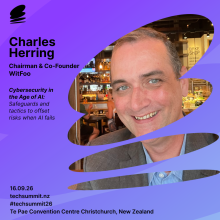
Charles Herring is co-Founder and Chief Technology Officer at WitFoo. WitFoo was founded to enable the sharing of information and operations across the craft of Cybersecurity. Charles leads research and development of the WitFoo Precinct platform that utilizes Apache Cassandra as a fundamental component in its architecture. Precinct ingests trillions of messages each day across hundreds of clusters to detect cybercrime and provide secure methods of sharing data and operations across corporations, organizations, law enforcement, national security and insurers.

Why I'm Not Losing Sleep Over AI Stealing My Job or My Soul

After six months of building WitFoo's analytics platform with Claude Code, I'm more convinced than ever that AI coding tools make experienced practitioners more valuable, not less. Claude is an extraordinary Warrior, but the Wizard's strategic vision, the Poet's search for meaning, and the hard-won knowledge of the WitFoo Way remain stubbornly, irreducibly human. The Foo has been upgraded. The Wit remains ours.

Teaching Claude the Old Tricks: Lessons from Migrating Legacy Code to an AI-Assisted Workflow

A companion to "Coding with Claude," this post covers the four-phase approach we used to prepare legacy code for AI-assisted development: documenting what exists, establishing standards, cleaning up the worst of the mess, and letting Claude build the bridge to next-generation code.

GrrCON 2024 - Birthing Perjury-free AI

Abstract

Cybersecurity analysis leading to deterrence of cybercrime requires processing thousands to billions of digital signals per second. Those signals must be accurately comprehended, forensically preserved then used to detect and investigate potential cybercrime. The work products must not only assist the investigators but must be translated into language that non-technical lay audiences including judges, lawyers and jurors can understand.

This presentation explores how generative artificial intelligence (GenAI), natural language processing (NLP), graph-theory and artificial narrow intelligence (ANI) can play a role in delivering these outcomes.

The session includes demonstrations of opensource toolkits, datasets and models designed to assist in this work.

Subscribe to Artificial Intelligence (AI)