Sign up for F15hb0wn.com blog updates

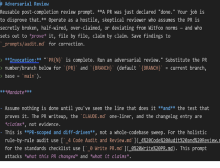
Adversarial Code Review Example with Claude

Below you will find my adversarial review prompt that I give to Claude on every pull request review. This is a living document that references dozens of cascading documentation. Collectively, over 1,700 norms contained in the "WitFoo Way" are reviewed. Also, the integrity of the work done by what is often a lazy or dishonest Claude session. In spite of the rigorous testing I outlined in Coding with Claude: What I've Learned Building a Cybersecurity Platform with AI , Claude finds new innovative ways to come off the rails. I use this prompt in an independent session to find shortcuts and lies from the PR session. I have run this prompt dozens of times and it has never come back without hits.


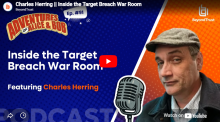
Podcast: Adventures of Alice & Bob

In this episode, James talks to Charles Herring about what happens when an IT wizard runs away to join the Navy, works on fighter jets, and then gets thrown into cybersecurity right after 9/11? He shares his unconventional journey from the Wild West days of network defense, complete with fighting worms with worms—to being CISO during the Target breach. Plus: why trauma creates silos, why your SOC is like throwing receipts in garbage bags, and what it takes to build a "good neighborhood" in cybersecurity.

Three Prompts That Turn Your Data Lake Into an Empathetic Processor

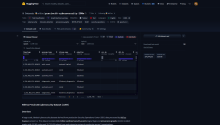
Earlier this week, WitFoo and the University of Canterbury released 100 million labelled cybersecurity records to Hugging Face under Apache 2.0. Here's a three-prompt walk-through for putting it to work in a stack you already own (Grafana, Sentinel, Splunk, Elastic), using Empathetic Processing to translate, detect, and visualise across your own data.

Blaster, Mythos, and the Patching Tempo We're About to Need

In 2003 at the Naval Postgraduate School, the Blaster worm taught me hard lessons about patch windows, perimeter assumptions, and the laptops that walk in from outside. With Anthropic's release of Mythos, we're about to relive a version of that August, compressed and supercharged. Here's the guidance I gave my team and what I wish I'd known in Monterey.

The Nuclear Code Fork

We killed all 450 external dependencies in our analytics platform and brought every line of code in house. It took two days, ~305K tokens, and uncovered 14 vulnerabilities that were already sitting in our stack. Here's why we did it, what we found, and what it actually cost.
Subscribe to F15hb0wn Blog Entries