
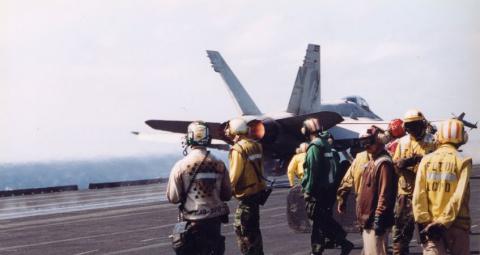
Rod
In November of 1998, I stepped onto the flight deck of the USS Kitty Hawk during night operations for the first time. I was called up to troubleshoot an avionics problem on one of the F/A-18 fighter jets in my charge. I had been in the US Navy for over three years at that point and was a reliable and respected technician, but I had not logged a week of sea time yet. I remember clearly the terror that washed over me as I stepped through the hatch.
I was wearing double hearing protection to prevent the dozens of jet engines a few feet from me from damaging my hearing. Unfortunately, it also meant I couldn't hear the young airman who was placed in charge of me (and who would consequently be my best man at my wedding five years later). I had goggles that prevented eye damage but obscured my vision. For operational and safety reasons, the light on deck was extremely limited. My flashlight had a blue lens blocking almost all of the light.
I could feel the engines vibrating my internal organs as they went to power on the catapult. I could feel the cold wind from the South China Sea coming over the bow, trying to throw my landlubber legs overboard. I could feel the deck pitching up, down, port and starboard, trying to rid itself of my slimy uselessness. My nostrils were filled with burning jet fuel.
I had not experienced it before that moment, or thankfully since, but my entire body froze.
Airman Rodriguez (Alex, or "Rod" later) immediately noticed and tried to snap me out of it. Eventually he put my left hand on his float coat and signaled me to follow him. I focused on the steps in front of me and tried to calm myself. I was desperately hoping this was an easy problem to fix because my mind was racing.
I would learn in a few minutes that if it had been easy, the flight deck troubleshooters would have already fixed it.
Dragon 305
We got to Dragon 305 and the flight deck Chief was there waiting. I asked how long we had to save the sortie. He told me five, maybe ten minutes. I went into the front wheelwell to check for maintenance codes and it was a mess.
But it was also simple. I've worked much harder gripes before but never when it viscerally felt like a matter of life and death.
The cooling and power systems were blowing air on me. I could see an army of feet scurrying in every direction as if they were trying to evade or slay a monster. The tempo and sensory overload was pushing my thoughts right out of my mind. To buy some additional time and hope for a clue, I plugged into the jet and asked the pilot for a description of what he was seeing. I slowed time down, focused on the wiring diagrams and publications that my mind could muster, and decided it was one of three things.
Two of them would take two to five minutes to try. The other one was more likely but would take the full ten minutes, if not more. My gut screamed it was the longer option.
The Part
I needed a part from below deck. Normally I would have sent Rod, but I wasn't yet qualified to be on the flight deck alone and he had to babysit me. I asked the Chief to call down for the part. The Chief scowled at my request and all I could do was put my mouth next to his ear and scream, "do you want to save this sortie, or not?!"
As we waited for the part, I started working contingency plans and gathering more clarity. We eliminated the other 2 options by the time the part arrived. I continued to calm myself and breathe to give myself a shot to produce a miracle idea if we needed it. The flight deck Chief was also an avionics technician and had little faith in this new guy's plan. I was new to the squadron. I was also a recently frocked Petty Officer, so my tender ego and budding reputation were on the line.
Chief became increasingly upset with my calmness as everyone else looked like they were in the third round of a boxing match, jumping foot to foot, bobbing and weaving. The part showed up. Rod installed it. I inspected it and we ran the tests. All systems checked good. The yellow shirts rolled it to the catapult and away it went.
Twenty-Seven Years Later
I've been thinking about that night a lot recently.
The noise, tempo, and risks of the current AI moment are virtually as paralyzing as an EA-6B Prowler at full power a few feet away. Everything and everyone is screaming to go faster. Vendors are dogpiling onto every trend with breathless promises. "Solutions" are being shipped before anyone has defined the problem (a theme I've been writing about since 2013). The sensory overload is constant and it pushes thoughts right out of your mind, just like that flight deck did.
I wrote recently about the OODA loop and how positive feedback loops are morally neutral. Put good principles in and they compound. Put garbage in and that compounds too, at 20 times the speed. I wrote about how AI-assisted development became the most potent productivity drug ever created and nearly wrecked my health. I wrote about the Wizard, the Warrior, and the Poet and how the Wizard's job is to decide what to build and why.
All of that is true. But there's something underneath all of it that I've been circling around without saying directly. Something that happened in the wheelwell of Dragon 305 that applies to this moment in tech more than any framework or metaphor I've come up with since.
The Calm Troubleshooter
When I was standing in that wheelwell, I had three options. Two were fast and easy. One was slow and hard. The fast options were tempting because the clock was ticking, the Chief was in my face, and every instinct screamed do something quick. But my gut told me the easy fixes wouldn't work. If they would have, someone else would have already tried them.
I chose the harder path. I called for a part that would take precious minutes to arrive. I stood there breathing while everyone around me was in full panic mode. The Chief was furious at my apparent lack of urgency. To him, I looked like a guy who didn't understand or care about the stakes. In reality, I was a guy who understood the stakes so clearly that I couldn't afford to waste time on things that wouldn't work.
That distinction matters right now more than it has in a very long time.
The cybersecurity industry (and the tech industry broadly) is in a third-round-of-a-boxing-match posture right now. Everyone is jumping foot to foot, bobbing and weaving, throwing punches at whatever moves. Vendor fatigue is real. The pressure to adopt AI right now and automate everything is immense. And in the middle of it all, there's a persistent, nagging voice telling experienced practitioners that they're too slow, too cautious, too old-school.
That voice is wrong.
Skipping the Easy Things That Won't Work
I've spent my career arguing that people matter more than machines. That process matters more than tools. That metrics matter more than marketing. That deterrence matters more than detection alone. These weren't popular positions when I took them, and in the current AI hype cycle, they're even less popular.
But here's the thing: The organizations I see making the most dangerous mistakes right now are the ones choosing the two-to-five minute options. They're automating broken processes at AI speed because it's fast and it looks like progress. They're skipping the hard work of defining what good looks like before letting the machine amplify whatever exists. They're doing the cybersecurity equivalent of swapping easy parts on a jet when the real problem is deeper in the system. (That instinct, diagnose the system rather than swap the nearest part, is the whole idea behind what the WitFoo team has finally written down as a diagnostic SIEM.)
I wrote about this exact dynamic in my OODA loop piece: the absence of standards means inconsistency piles up 20 times faster than before, the absence of testing means bugs compound and cascade at a rate that makes manual debugging nearly impossible. Substitute "no linting" with "no defined processes" and "no testing" with "no measurement of outcomes" and you have the state of AI adoption in most security operations centers today.
The value-to-cost ratio of AI is shifting, and the window to get the foundations right is closing. The organizations that take the time to breathe, define their processes, and build the infrastructure before letting AI amplify everything are the ones that will have their jets in the air when it matters.
The Ship Needs You
I want to speak directly to the people who feel like I felt on that flight deck. The ones who are standing in the middle of the noise and the tempo and the pressure and feeling frozen. The ones who look around and see everyone else bobbing and weaving and wonder if they're the only ones who think the easy fixes won't work. The ones whose gut is screaming that the harder path is the right one, but who aren't sure their ego and reputation can survive being the calm person in a room full of panic.
I know what that feels like. I've felt it on the deck of a carrier in the South China Sea. I've felt it in board meetings where everyone wanted faster growth at any cost. I've felt it watching the AI hype cycle accelerate past every reasonable speed limit. I've felt it as recently as last month in bed, recovering from my own AI bender.
If you're wired like me and think you're not ready, worthy, or fast enough, take it from this now salty and trusty shellback of a sailor: this ship needs you to keep breathing and making hard decisions.
The flight deck doesn't need more people jumping foot to foot. It needs calm troubleshooters who skip the easy and fast things that won't work and choose the harder and wiser path. The Chief might be furious with your apparent lack of urgency. The vendor might tell you that you're falling behind. The hype cycle might make you feel like a relic.
None of that matters if the jet flies.
Wrap Up
Dragon 305 made its sortie that night. I didn't get a medal, an attaboy, or a thank you. I walked off the flight deck as terrified as I entered it. In the next few years, Alex and I would save dozens of sorties in war zones (the stories of Fish and Rod for another time.) I would be awarded commendations and medals. But every time I was calmly standing on that flight deck building a complex troubleshooting plan in the dark of the Persian Gulf or hauling ass across the Indian Ocean to deal with a fresh conflict, every new flight deck Chief would come unglued at my misdiagnosed disinterest.
The world looks a lot like that flight deck right now. It's dark. It's loud. The deck is pitching under your feet. Everyone is moving fast and expecting you to keep up. Your senses are overwhelmed and your instinct might be to freeze or to do the fastest thing available just to look like you belong.
Don't. Breathe. Trust your training. Call for the right part and right plan, even if it takes longer. Let the Chief be upset. The sortie is what matters, and the sortie needs the person who chose the harder path and got it right.
If the world ever needed more people taking deep breaths and making hard decisions in tech, it's now.
Post Script
The photo at the top of this blog entry was taken a year or two after my first night on the flight deck. This was day operations in the Persian Gulf. It's the same jet (Dragon 305) from my story. It was in the days of SLR cameras and film that needed a dark room. While I did muster the courage to take some photos on the flight deck during slow day ops, I never had the audacity or photography skills to try to pull it off during night ops.
Charles Herring is co-founder and CEO of WitFoo, a cybersecurity company building collective defense solutions. He is a US Navy veteran and speaks regularly at security conferences including GrrCON, BSidesSPFD, and Secure360. You can find him on LinkedIn.